Where Can I Buy a Whetstone Flattener Near Me

Sharpening stones, or whetstones, are used to sharpen the edges of steel tools and implements, such as knives, pair of scissors, scythes, razors, chisels, paw scrapers, and plane blades, through grinding and honing.
Such stones come in a broad range of shapes, sizes, and material compositions. They may exist flat, for working apartment edges, or shaped for more complex edges, such equally those associated with some wood carving or woodturning tools. They may be equanimous of natural quarried material or from man-made textile. They come up in various grades, which refer to the dust size of the abrasive particles in the rock. (Grit size is given equally a number, which indicates the spatial density of the particles; a higher number denotes a higher density and therefore smaller particles, which give a finer stop to the surface of the sharpened object.) Stones intended for use on a workbench are called demote stones, while minor, portable ones, whose size makes it hard to describe large blades uniformly over them, especially "in the field," are called pocket stones.
Often whetstones are used with a cutting fluid to raise sharpening and carry abroad swarf. Those used with h2o for this purpose are often called h2o stones or waterstones, those used with oil sometimes oil stones or oilstones.
Terminology [edit]
 | Await up whet or moisture in Wiktionary, the free lexicon. |
Though "whetstone" is frequently mistaken as a reference to the water sometimes used to lubricate such stones, the term is based on the word "whet", which means to sharpen a blade,[one] [two] not on the word "wet." The verb nowadays to draw the process of using a sharpening rock for a knife is simply to acuminate, but the older term to whet is still sometimes used, though then rare in this sense that it is no longer mentioned in, for case, the Oxford Living Dictionaries.[3] [4]
Natural stones [edit]
Natural whetstones are typically formed of quartz, such as novaculite. The Ouachita Mountains in Arkansas are noted as a source for these. Novaculite is also found in Syria and Lebanon, previously a part of the Ottoman (Turkish) empire, hence the use of the older proper name in America of Turkey rock.[v]
Like stones have been in use since antiquity. The Roman historian Pliny described utilize of several naturally occurring stones for sharpening in his Natural History. He describes the use of both oil and water stones and gives the locations of several ancient sources for these stones.[six]
One of the most well-regarded natural whetstones is the xanthous-gray "Belgian Coticule", which has been legendary for the edge it tin can give to blades since Roman times, and has been quarried for centuries from the Ardennes. The slightly coarser and more plentiful "Belgian Blue" whetstone is found naturally with the yellow coticule in adjacent strata; hence two-sided whetstones are available, with a naturally occurring seam between the yellow and blue layers. These are highly prized for their natural elegance and beauty, and for providing both a fast-cutting surface for establishing a bevel and a finer surface for refining it. This stone is considered one of the finest for sharpening direct razors.[ commendation needed ]
The hard rock of Charnwood Forest in northwest Leicestershire, England, has been quarried for centuries,[7] and was a source of whetstones and quern-stones.
Natural stones are often prized for their natural dazzler equally stones and their rarity, adding value as collectors' items. Furthermore, each natural rock is different, and there are rare natural stones that contain abrasive particles in dust sizes effectively than are currently available in bogus stones.[ citation needed ]
Artificial (synthetic) stones [edit]
Artificial stones usually come in the course of a bonded abrasive equanimous of a ceramic such equally silicon carbide (carborundum) or aluminium oxide (corundum). Bonded abrasives provide a faster cutting action than natural stones. They are normally bachelor as a double-sided block with a fibroid grit on one side and a fine dust on the other enabling i stone to satisfy the basic requirements of sharpening. Some shapes are designed for specific purposes such equally sharpening scythes, drills or serrations.[8]
Modern constructed stones are more often than not of equal quality to natural stones, and are ofttimes considered superior in sharpening operation considering of consistency of particle size and control over the backdrop of the stones. For example, the proportional content of abrasive particles as opposed to base of operations or "binder" materials can be controlled to make the stone cut faster or more than slowly, as desired.[9]
The use of natural stone for sharpening has macerated with the widespread availability of loftier-quality artificial stones with consistent particle size. As a upshot, the legendary Honyama mines in Kyoto, Japan, have been closed since 1967. Belgium currently has only a single mine that is still quarrying Coticules and their Belgian Blueish Whetstone (BBW) counterparts.[10]
Japanese waterstones [edit]

The Japanese traditionally used natural sharpening stones wetted with water, equally using oil on such a stone reduces its effectiveness. The geology of Japan provided a blazon of stone which consists of fine silicate particles in a dirt matrix, somewhat softer than novaculite.[11] Besides this clay mineral, some sedimentary rock was used past the Japanese for whetstones, the well-nigh famous being typically mined in the Narutaki District just northward of Kyoto.[ citation needed ]
Historically, there are three broad grades of Japanese sharpening stones: the ara-to, or "crude stone", the naka-to or "middle/medium rock" and the shiage-to or "finishing stone". There is a 4th type of stone, the nagura, which is not used straight. Rather, it is used to form a cutting slurry on the shiage-to, which is often too hard to create the necessary slurry. Converting these names to absolute dust size is difficult as the classes are broad and natural stones have no inherent "dust number". Equally an indication, ara-to is probably (using a non-Japanese arrangement of grading dust size) 500–chiliad grit. The naka-to is probably 3000–5000 grit and the shiage-to is likely 7000–10000 grit. Current synthetic grit values range from extremely coarse, such as 120 grit, through extremely fine, such as 30,000 grit (less than half a micrometer abrasive particle size).[ citation needed ]
Diamond plate [edit]
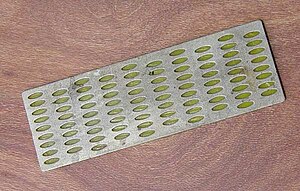
A diamond plate is a steel plate, sometimes mounted on a plastic or resin base, coated with diamond grit, an annoying that will grind metallic. When they are mounted they are sometimes known as diamond stones.[12] The plate may have a series of holes cut in it that capture the swarf cast off equally grinding takes place, and cuts costs by reducing the amount of abrasive expanse on each plate. Diamond plates can serve many purposes including sharpening steel tools, and for maintaining the flatness of man-fabricated waterstones, which can become grooved or hollowed in use. Truing (flattening a stone whose shape has been changed as it wears abroad) is widely considered essential to the sharpening process merely some hand sharpening techniques utilise the high points of a non-truthful stone. As the merely function of a diamond plate to wearable away is a very thin blanket of grit and agglutinative, and in a good diamond plate this vesture is minimal due to diamond's hardness, a diamond plate retains its flatness. Rubbing the diamond plate on a whetstone to true (flatten) the whetstone is a modern alternative to more traditional truing methods.[13]
Diamond plates are available in various plate sizes (from credit bill of fare to demote plate size) and grades of grit. A coarser grit is used to remove larger amounts of metal more rapidly, such as when forming an border or restoring a damaged edge. A finer grit is used to remove the scratches of larger grits and to refine an edge. There are 2-sided plates with each side coated with a different grit.[14]
The highest quality diamond sharpeners use monocrystalline diamonds, unmarried structures which volition not break, giving them an excellent lifespan. These diamonds are bonded onto a precision basis surface, fix in nickel, and electroplated. This process locks the diamonds in place.[14]

Hobby microscope view of a 220 grit diamond sharpening stone. Tiny diamonds are electroplated to a perforated metal carrier strip and bonded to a plastic backing. The characteristic identified with the ruby-red line across it measures about 0.08 mm across. The dark area at upper left is a void designed to allow for swarf created during sharpening to be cleared from the diamonds. This relatively coarse stone would be used to reshape a damaged blade border which would be refined by finer grit stones.
Grit size [edit]
There is no dominant standard for the relationship betwixt "grit size" and particle diameter. Part of the difficulty is that "grit size" is used to refer to the smoothness of the finish produced by a sharpening rock, and not just the bodily size of the grit particles. Other factors apart from particle diameter that bear on the finish (and thus the "grit size" rating) are:
- the shape of the abrasive particles,
- how much of each particle is exposed by the binder,
- friability (whether the annoying particles can be fractured into smaller ones past the pressure of grinding or polishing),
- the hardness of the abrasive particles, and
- the chemical composition of the abrasive particles (common abrasives include diamond, cubic boron nitride (CBN), chromium(Iii) oxide, tungsten carbide, silicon carbide and other ceramics).
In constructed stones, the grit size is related to the mesh size used to select the particles to exist included in the annoying. Sandpaper also uses a similar system.
Here are some typical sharpening stone grit sizes and their uses when sharpening steel knives:
| Grit size | Approximate particle diameter | Typical utilise[fifteen] [16] |
|---|---|---|
| 200 | fourscore μm | Removing chips from a damaged blade |
| 500 | 30 μm | Roughly sharpening a blunt edge |
| k | 8 μm | Smoothing a rough edge into a medium edge |
| iv,000 | iv μm | Smoothing a medium border into a precipitous edge for cutting meat |
| 8,000 | 2 μm | Further smoothing a sharp edge for cutting fish or vegetables (sinews in meat will bend an edge this sharp) |
| 30,000 | 0.5 μm | Polishing an border to a mirror-smooth (but peradventure fragile) stop. |
Standards for dust size measurements include JIS, CAMI, ANSI, FEPA-P (for sandpaper), FEPA-F (for metallic abrasives), and various trademarked standards for individual visitor production ranges.
 [17] [18] [19] [20]
See also [edit]
- Grinding bike
- Honing steel
- Knife sharpening
- Razor strop – Device for straightening and polishing blades
- Scary sharp
- Sharpening a scythe – Agronomical reaping paw tool
- Sharpening jig
References [edit]
- ^ ""Whet", Lexicon.com". Retrieved 25 July 2016.
- ^ "Online Etymology Dictionary". Retrieved 25 July 2016.
- ^ Oxford Living Dictionaries
- ^ ""Stoning", Dictionary.com". Retrieved 25 July 2016.
- ^ Adam Cherubini (12 Oct 2011). "What is an Oilstone?". Popular Woodworking mag. Retrieved 22 Feb 2017.
- ^ Leon Southward. Griswold, The Novaculites of Arkansas in Annual Report of the Geological Survey of Arkansas, Volume 3, 1892, available on Google Books
- ^ Ambrose, M et al. (2007). Exploring the Landscape of Charnwood Forest and Mountsorrel. Keyworth, Nottingham: British Geological Survey
- ^ Steve Bottorff, Sharpening Fabricated Piece of cake: A Primer on Sharpening Knives and Other Edged Tools, Pocketknife Earth Publications, 2002, ISBN 0940362198, pp.29-39
- ^ English language, John (2008), Woodworker's Guide to Sharpening: All You Demand to Know to Keep Your Tools Sharp, Fox Chapel Publishing, p. 22, ISBN978-one-56523-309-6.
- ^ coticule.be
- ^ David A.Warren, Getting an Border the Japanese Style, Popular Mechanics, Jan 1984, pp. 104-107
- ^ Thomas Klenck, Tool Test: DMT Diamond Sharpeners, Pop Mechanics, March 1991 pp.62-63
- ^ Miller, Jeff (2012). The Foundations of Better Woodworking: How to use your torso, tools and materials to practise your best work, Pop Woodworking Books, 2012 ISBN 1440321019, page 120
- ^ a b wonkeedonkeetrend.co.united kingdom of great britain and northern ireland
- ^ "Whetstones: information technology'south all in the grit!". sohoknives . Retrieved 3 January 2019.
- ^ "Sharpening stone grit nautical chart". sharpeningsupplies . Retrieved 3 January 2019.
- ^ "The Chiliad Unified Dust Nautical chart". bladeforums.com. p. 1. Retrieved 3 Jan 2019.
- ^ "The Chiliad Logarithmic Grit Chart". gritomatic.com . Retrieved 3 January 2019.
- ^ "Stone, Belt, Newspaper, Pic and Compound Dust Comparison" (PDF). imcclains.com . Retrieved iii January 2019.
- ^ "Conversion Chart Abrasives - Dust Sizes". Retrieved 3 Jan 2019.
 | Wikimedia Commons has media related to Whetstones. |
Source: https://en.wikipedia.org/wiki/Sharpening_stone

Post a Comment for "Where Can I Buy a Whetstone Flattener Near Me"